


The Ultimate Guide to Lighting Your Home (Beyond Tube Lights!)
Lighting your home isn't just about switching on one tube light in the middle of the ceiling. The real magic happens when you layer it. General lighting gives the whole room a soft glow, task lights focus on what you're doing—like cooking in the kitchen, reading in bed, or working at a desk—and accent lights add mood by highlighting a wall, a plant, or a favorite piece of art. In Mumbai, where mornings can be bright, afternoons harsh, and monsoon days endlessly grey, the right mix of warm and cool lights helps your home stay balanced and welcoming. LEDs with dimmers not only let you control the mood but also keep electricity bills under check. And here's the simple trick to remember: lumens tell you how much light a bulb makes, lux tells you how bright it feels where it lands. When you get this layering right, your flat doesn't just look better—it feels alive, comfortable, and truly like home.
So, picture this—you've just moved into your new Mumbai flat. You flick on the switch and bam—the whole room blazes under one buzzing tube light. Functional? Sure. But welcoming? Not really. Doesn't it feel a little too harsh, like the room's missing its soul? The truth is, lighting isn't just about helping you see—it's about how your home feels. Does it energize you on a Monday morning? Calm you after a long commute? Make dinner feel cozy instead of clinical? That's what good lighting does—it sets the mood for your life.


What on Earth Are Lumens and Lux?
Alright, let's be honest—have you ever stood in a lighting store, staring at all those boxes that scream "800 lumens!" or "3000 K, 12W, 1200 lm" … and thought: Wait, what does any of this even mean? Don't worry, you're not alone. Most of us just pick a bulb that looks bright enough and hope for the best. But here's the deal: understanding two little words—lumens and lux—can completely change how you light your home.
Lumens = How much light you get
Think of lumens as the total bucket of light a bulb produces. Imagine holding a torch in your hand—when you switch it on, all the light pouring out in the bucket is measured in lumens. The higher the lumens, the more light it's giving off.
💡For example
- A candle = about 12 lumens (that's why you can barely see with just one).
- A 60-watt old-school bulb = around 800 lumens.
- A bright LED ceiling downlight = 1200+ lumens.
So, when you see "1200 lumens" on the box, it's basically telling you how strong that bulb's "light engine" is.


Lux = How much light actually falls on something
Now here's where it gets interesting. Lumens tell you how much light is made, but lux tells you how that light is spread out over an area.
Think of pouring water:
- If you pour a bucket (1000 lumens) into a small cup, it fills up quickly—lots of light in a small area = high lux.
- But if you pour that same bucket over a football field, it barely wets the ground—lots of light, but spread too thin = low lux.
That's lux: lumens per square meter.
💡 For example
- Reading a book comfortably = about 300–500 lux on the page.
- Cooking in your kitchen = 500–750 lux on the counter.
- A cozy living room evening = 100–200 lux.


Why Both Matter in Your Flat
Here's the trap: you can buy a bulb with tons of lumens, but if the light is scattered across the whole room, your work desk still feels dull. That's why kitchens need under-cabinet lights (high lux, concentrated on the counter), while living rooms can survive with a soft ambient glow (lower lux, spread out).
So, the simple rule:
- Lumens = how much light the bulb makes.
- Lux = how bright it feels on the spot you actually use.
Tip for Mumbai flats: When buying, don't just look at wattage (old habit!). Check the lumens on the box. Then think: Where will this light fall? A 1200 lumen bulb in the center of your living room will feel very different from the same bulb shining directly on your dining table
Move Beyond the Tube Light
Let's be real—most of us grew up with a single ceiling light doing all the work. But here's the secret: lighting has layers. Three of them, in fact—general, task, and accent.
General lighting is your base layer, the one that fills the room. Imagine your living-dining area. Instead of one lonely tube light, you've got a ceiling cove with hidden LED strips and a few recessed downlights. Suddenly, the space glows evenly at 300–500 lux, warm enough for evenings but still bright enough for those family get-togethers. And bedrooms? They work best at a softer 150–300 lux, giving you comfort without glare.


Then comes task lighting—the focused stuff. Ever tried chopping vegetables in a Mumbai kitchen only to realize the overhead light casts your own shadow on the counter? Annoying, right? Under-cabinet LED bars fix that instantly, spilling 750 lux right onto the workspace. Same with a study desk lamp—500 lux where you need it most, no eye strain. Even in your bedroom, a pair of wall-mounted reading lights or vertical fixtures around the mirror turn daily routines from frustrating to smooth.
And finally, accent lighting—the fun part. This is where your personality sneaks in. Think of a lime-plaster wall in your living room. Add two adjustable spotlights grazing across it, and suddenly it's art. Or a niche shelf with brass figurines glowing under a hidden LED strip. Even that lone palm on your balcony? Light it from below, and it becomes a statement piece. That's what accent lighting does—it creates stories in your home.
Work With Mumbai's Sun (and Clouds)
Here's a question: have you noticed how different your home feels in January versus July? That's because Mumbai's light keeps changing.
In January, east-facing rooms glow with silvery morning light. Beautiful, but sometimes a little too cold. Add a warm 3500 K glow indoors, and it balances perfectly. By October, the noon sun beats down harsh and strong—so you pull on the sheers, dim your ambient lights, and suddenly the space feels calm again.

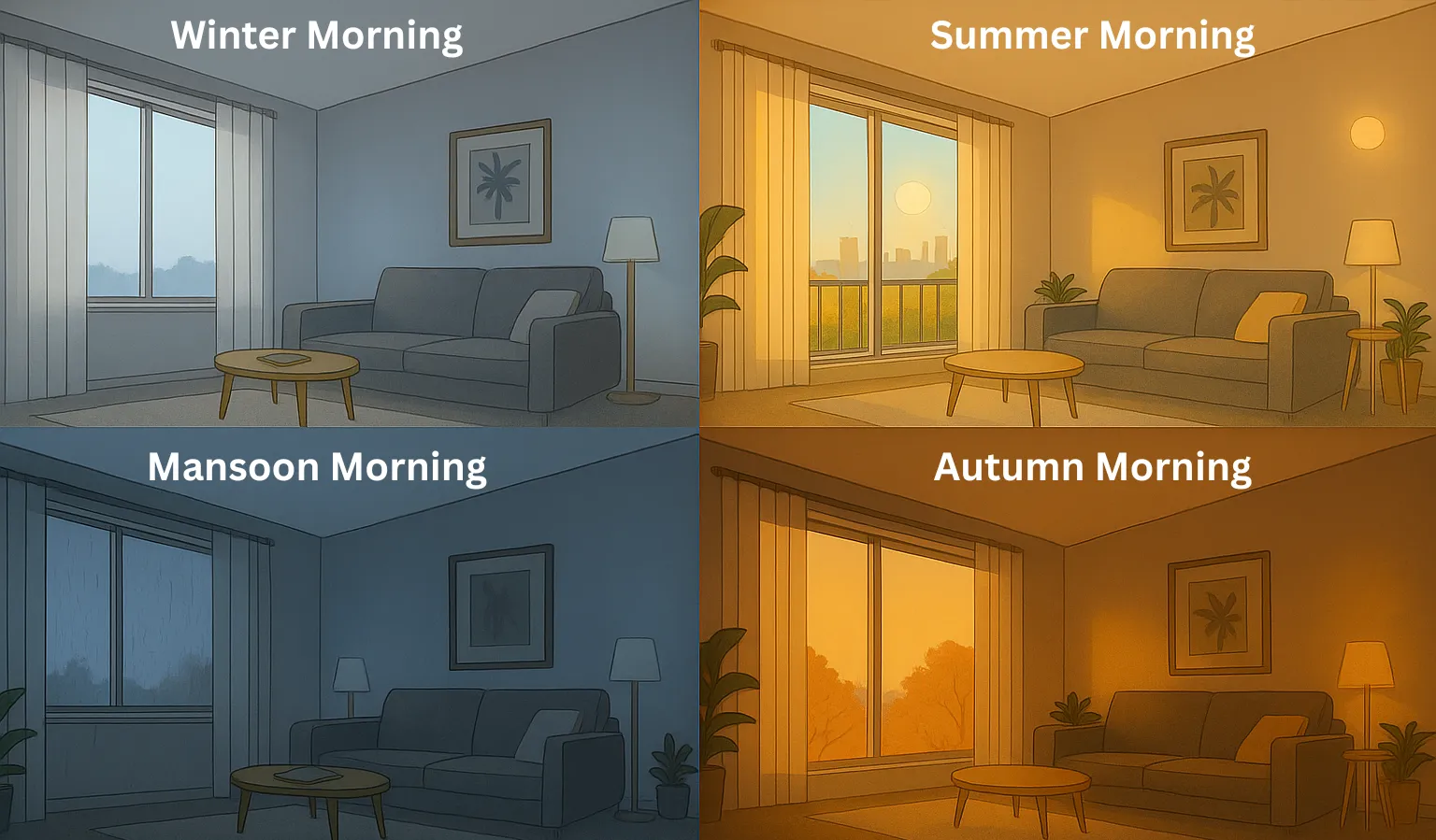
But the real test? The monsoon. For weeks, the city barely sees three hours of sunshine a day. Ever walked into your living room at noon in July and felt like it was evening already? That's where layered lighting saves the day. Brighter 4000 K ambient fills the dullness, wall washers restore contrast, and warm accents make evenings feel golden even when it's grey outside.
Evenings flip the script—you dim your ambient lights to 30–50% and let warm 2700 K accents take over. Instantly, the mood shifts. Your flat slows down with you, inviting you to rest.
Keep an Eye on Bills
Now, let's talk money. Have you ever opened your Mumbai electricity bill and felt your heart skip a beat? Once you cross 300 units, tariffs climb steeply. That's why efficient lighting isn't just design—it's common sense.
BEE star-rated LEDs are your best friend here. Pair them with dimmers, and you can cut your lighting costs in half. The trick? Don't flood every room with brightness. Keep your general lighting modest, save the punch for where you need it—kitchen counters, mirrors, desks—and let accents do the mood work. You'll get a layered, luxurious feel without burning through your budget.
A Flat That Gets It Right
Enough theory—let's picture a real flat. Say it's a two-bedroom, 750 sq. ft space in Mumbai. The style? Modern Indian Minimalism—clean lines, muted tones, warm wood. The budget? Around ₹7–8 lakhs, lighting included.
The living-dining area, 18 by 12 feet, is the heart. Cove lighting with dimmable LEDs hugs the ceiling, four recessed downlights spread a soft 400 lux glow, and a matte black pendant drops warm light right over the teak dining table. One wall, finished in lime plaster, shimmers under two grazing spotlights. A compact grey sectional sofa anchors the space, and brass-accented decor adds warmth. Even the indoor plants get their spotlight—literally—with tiny floor uplights.
The kitchen, 10 by 8 feet, is all about clarity. Recessed ceiling lights create a 400 lux base, while under-cabinet strips blast 750 lux onto the counters. White quartz and pale wood reflect the light beautifully, and a single pendant above the breakfast counter keeps it from feeling clinical.


The master bedroom, 12 by 12 feet, leans into calm. Cove lighting creates a soft 200 lux glow, twin wall-mounted reading lamps add flexibility, and a concealed strip inside the wardrobe makes sure colours look accurate under CRI 90 LEDs. Beige walls, a cane headboard, and a muted kilim rug keep things soothing, while the lighting enhances textures without overwhelming them.
The second bedroom doubles as a study. A recessed ceiling grid gives 350 lux general light, a desk lamp by the window adds focus, and shelves glow under hidden strips so books and curios stand out even on rainy days. A sofa-cum-bed makes it guest-ready, keeping it flexible.
And then, the balcony—the little escape. A warm LED strip under the railing casts a gentle glow, while one uplight makes a tall areca palm glow like sculpture. At night, the balcony feels magical, perfect for tea in the rains or stargazing when skies are clear.
Let Light Lead the Way
When you layer your lighting right, your home transforms with you. In the morning, it's bright and energizing. In the afternoon, it adapts to glare or gloom. At night, it softens, slowing everything down. And through the monsoon, when skies turn dull, your home glows from within like a lantern.
That's the real magic of lighting—it's not just a utility. It's the silent architecture of your life, shaping how your space feels every single day.


Final Thought: Once you've lived with layered lighting, you'll never look at that lonely tube light the same way again. Because light doesn't just fill a room—it shapes your mood, defines your spaces, and gives every corner of your home a purpose. It becomes the rhythm of your mornings, the calm of your evenings, and the warmth that carries you through the monsoon gloom. In a city like Mumbai, where sunlight changes every day, that kind of comfort is truly priceless.
Until next time, here's to building homes that don't just shine—but glow with life.
Happy Designing
Transform Your Home Today
Ready to bring these ideas to life? Our design experts are here to help you create the home you've always dreamed of, tailored to your style and budget.
Schedule Your Free Consultation